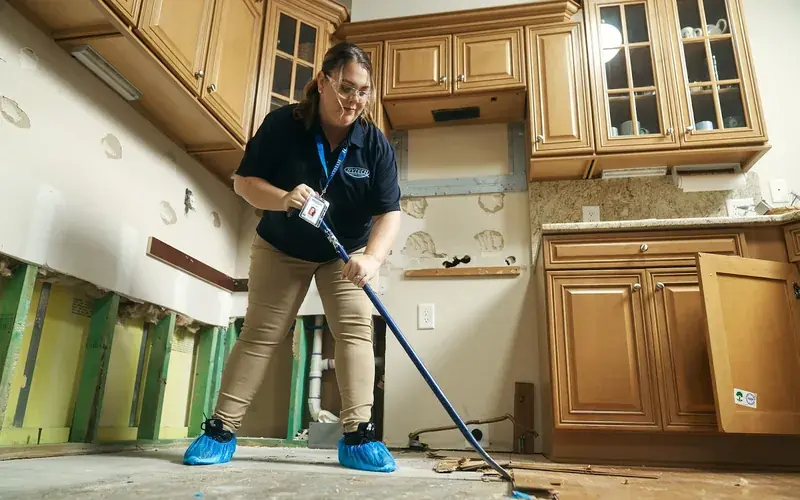
Standing water is the emergency, and getting it out fast is the most important step in any water loss. Every hour it sits, it wicks further into the slab, drywall, and cabinets, and in Central Texas humidity a wet home does not dry on its own. The crew arrives across Dale and Caldwell County with truck mounted and portable extractors, pulls the water out first, then maps what is left.
How water extraction & removal is handled in Dale
Call & dispatch
The response team answers 24/7, gets your address, and sends the nearest Central Texas crew with truck-mounted extractors, air movers, and moisture meters.
On-site assessment
The crew finds the source and the full reach of the water, including what soaked into subfloor, cabinets, and the wall cavities you cannot see.
Extract & dry
The extraction crew pulls the standing water fast, then runs air movers and dehumidifiers to a measured dry standard, not just the surface.
Verify & document
Moisture readings are logged until the structure reads dry, then the loss is documented with the photos and daily readings an adjuster needs to move a claim.
Why fast extraction matters in the humidity here
Speed matters so much here because of the climate here. Warm, humid Gulf air keeps indoor moisture high, so water that would slowly evaporate elsewhere instead lingers and spreads into everything it touches.
- Water travels sideways through a slab home, wicking under baseboards and into wall cavities far from where it started.
- Soaked drywall, carpet pad, and cabinet bases can begin to grow mold within 24 to 48 hours in the Texas heat.
- The longer water sits, the more material has to be removed rather than dried and saved.
Fast extraction keeps a wet floor from becoming a gutted room. Whether the water came from a flash flood, a burst line, or a backed up drain, pulling it out quickly protects the parts of your home that can still be saved.
Truck mounted and portable extraction
Different losses need different tools, and crews bring both to every call. The right combination clears the water faster and reaches spots a single machine cannot.
- Truck mounted extractors move high volumes of water quickly, which matters when a whole floor is under water.
- Portable extractors reach upstairs rooms, tight closets, and far corners a truck mount hose cannot.
- Weighted tools press water out of carpet and pad so flooring has a chance to dry.
- Where the water is category two or three, crews extract and dispose of it safely rather than moving it around.
When a sewer or septic backup is involved, the water is a health hazard and the job crosses into the sewage and black water cleanup, handled in protective gear with disinfection built in.
Moisture mapping after the water is gone
Pulling out the standing water is only half of extraction. The other half is finding the water you cannot see, because a floor that looks dry on top can still be soaked underneath.
The crew maps the affected area with moisture meters and a thermal camera, marking how far the water wicked into the slab, walls, and subfloor. That map shows exactly where to aim the drying equipment and gives a baseline to measure against, so nobody is guessing when the job is done. The EPA flooding cleanup guidance and Ready.gov flood pages are plain references on why fast, thorough water removal comes first.
What comes next after extraction
Extraction sets up everything that follows. Once the water is out and the map is made, the home moves straight into drying so the moisture readings start dropping instead of holding. The step that follows is structural drying and dehumidification, and you can estimate the range for a loss with the water damage cost calculator before you call.
Standing water in your Dale home right now? Talk to a Central Texas crew now. Crews arrive fast with truck mounted extractors and get the water out before it spreads.
☎ Call (737) 302-5065The first hour decides how much you lose
In Flash Flood Alley a home can go from a trickle to inches of standing water in a single storm off Plum Creek or a low water crossing. Homes that come through with the least damage are the ones where water came out fast. If water is standing in your home, call and get extraction started rather than waiting, because in the humidity here the clock is the difference between drying a room and rebuilding it.
Why Dale and Caldwell County call the local pros first
Rapid local response
The response team answers 24/7, and the nearest crew heads out the moment you call, day or night, across Dale, Lockhart, Kyle, Buda, and San Marcos.
IICRC S500 drying standard
Trained crews with truck-mounted extractors, air movers, and moisture meters, drying to the IICRC S500 standard, not a mop and a box fan.
Claim-ready documentation
The loss is documented with photos and daily moisture readings, the paperwork an adjuster needs to move a claim.
Local water experts
Flash floods off Plum Creek, freeze bursts, and slab leaks on Blackland clay, so the local pros know how water moves through homes here.
Serving Dale, Caldwell County, and the corridor
Seated near Dale on FM 1854, the response team covers Caldwell County and the Kyle, Buda, and San Marcos corridor, day or night.
Seated near Dale on the FM 1854 corridor, local crews cover all of Caldwell County and the Kyle, Buda, and San Marcos corridor, day or night, with rapid local response.
Coverage runs across Dale, Lockhart, Kyle, Buda, San Marcos, Luling, Martindale, Maxwell, Niederwald, Uhland, Mustang Ridge, and Del Valle.
See every community and ZIP covered ›Related restoration services
Common questions, answered
How fast can you start extracting water in Dale?
Crews answer live 24/7 and reach most of Dale and Caldwell County, a little longer to the far edges. Extraction is the most time sensitive step in any water loss, so the nearest crew rolls the moment you call, with truck mounted and portable units ready.
Why is getting the water out first so important?
Every hour standing water sits, it wicks deeper into the slab, drywall, and cabinets, and in the humidity here that spread happens fast. Pulling the water out quickly is what keeps a wet floor from turning into a gutted room, so it always comes before anything else.
What is the difference between truck mounted and portable extraction?
Truck mounted extractors move high volumes of water quickly, which matters when a whole floor is flooded. Portable units reach upstairs rooms, closets, and tight corners a truck mount hose cannot. Crews bring both so the water comes out fast and completely.
Do I still need drying if you extract all the water?
Yes. Extraction removes the standing and absorbed water you can pull out, but the slab, framing, and drywall stay damp underneath. Structural drying with air movers and dehumidifiers finishes the job and brings the moisture readings back to normal so mold does not follow.
How do you find water I cannot see?
Crews map the area with moisture meters and a thermal camera, which show how far the water wicked into the slab, walls, and subfloor. That map tells us where to aim the drying equipment and gives a baseline to measure against, so the job is finished by readings, not guesswork.
Can you handle a whole house that flooded?
Yes. Crews scale the crew and equipment to the loss, from a single wet room to a whole home under water after a flash flood. High volume truck mounts and multiple portable units let us clear a large area quickly and move straight into drying.
Is dirty or contaminated water handled differently?
Yes. Grey water and black water from a sewer or septic backup are health hazards, so crews extract and dispose of them safely, in protective gear, and disinfect the area rather than just moving the water. That crosses into the sewage and black water cleanup work.
Will insurance pay for water extraction?
Sudden accidental water losses are usually covered, and fast extraction actually lowers the total claim by saving material that would otherwise be lost. The water and the damage are documented with photos and readings. Coverage depends on your policy, so it is worth checking with your own insurer.
Dale's water damage crew is standing by
Water sitting means damage spreading. Call Lone Star Water Restoration and a local crew heads out across Caldwell County, day or night.
(737) 302-5065Talk to a Central Texas crew now, day or night