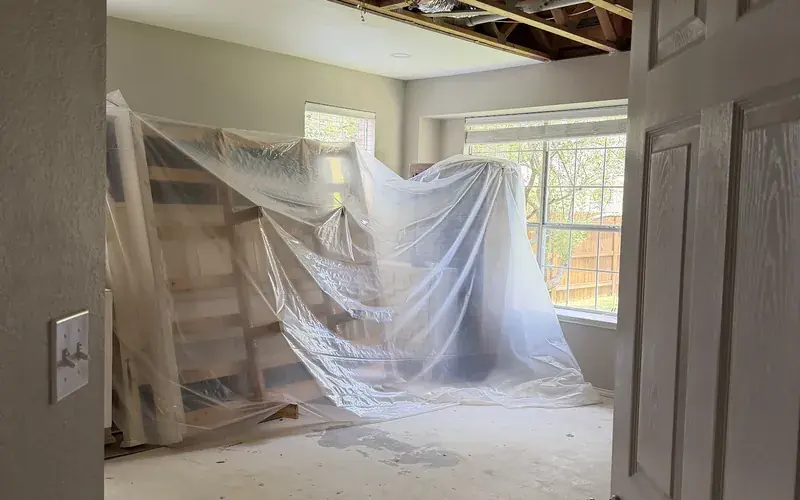
Central Texas storms are inland and violent. A spring or fall supercell can drive rain sideways through a roof, bruise the shingles with hail, and leave water running down the walls before the sky clears. Crews answer live 24/7 and reach Dale, Kyle, Buda and across Caldwell County to stabilize the home and dry it out. Call (737) 302-5065.
How storm damage water cleanup is handled in Dale
Call & dispatch
The response team answers 24/7, gets your address, and sends the nearest Central Texas crew with truck-mounted extractors, air movers, and moisture meters.
On-site assessment
The crew finds the source and the full reach of the water, including what soaked into subfloor, cabinets, and the wall cavities you cannot see.
Extract & dry
The extraction crew pulls the standing water fast, then runs air movers and dehumidifiers to a measured dry standard, not just the surface.
Verify & document
Moisture readings are logged until the structure reads dry, then the loss is documented with the photos and daily readings an adjuster needs to move a claim.
Central Texas storms and how water gets in
This is not the coast, so the threat is not hurricane surge. It is the supercell: wind-driven rain forced through roof seams, flashing, skylights and window frames, and hail that bruises a roof so it leaks in the next storm. Season peaks hit in spring and fall, when warm Gulf moisture meets a cold front over the I-35 corridor. The NOAA Storm Prediction Center tracks these severe-weather setups, and a single supercell can hail a whole neighborhood, then push rain through every opening it just made.
- Wind-driven rain pushed through roof seams, flashing and window frames
- Hail bruising that opens a roof to leaks in later storms
- Blown-off shingles and lifted flashing after straight-line winds
- Water tracking into the attic and down interior walls
Immediate storm water cleanup and stabilization
Lone Star Water Restoration works a storm in a set order: stop the water coming in, then remove what already did. For the roof and flashing repair itself, the roof leak water damage crew handles the envelope.
- Emergency tarping and board-up to stop the active intrusion
- Extraction of standing water from floors, closets and low spots
- Removing soaked insulation and drywall that cannot be dried in place
- Drying the framing and finishes to a measured reading
Before anyone enters, crews check for electrical hazards and sagging, water-loaded ceilings, since wind-driven water can reach outlets and fixtures.
Hail, wind-driven rain and hidden attic moisture
The damage you can see is rarely the whole story. Water that comes through the roof collects in the attic and can show up days later as a stained, sagging ceiling or a musty smell. Crews check the attic and wall cavities with moisture meters so nothing stays wet behind the drywall. The NWS thunderstorm safety pages explain how fast these storms build here.
- Attic insulation and decking that hold water out of sight
- Moisture wicking along top plates into wall cavities
- Ceilings that stain or sag days after the storm
- The structural drying crew monitors until it reads dry
Working with your storm claim
Storm water intrusion is one of the losses homeowners insurance most often covers, and the claim moves faster when the damage is documented well. Crews photograph the point of entry, the hail or wind evidence and the interior damage, log moisture readings, and write a clear scope, then bill most carriers directly where the policy allows. Acting fast keeps the loss reading clean, with less secondary damage for an adjuster to sort out.
Cost depends on how far the water traveled and how much material has to come out. Size a range on the water damage cost calculator, then call for an exact quote.
Storm putting water in your home? Call now and a local crew rolls to tarp the opening and start drying.
☎ Call (737) 302-5065Was it the roof, or a full storm cleanup?
If the storm only opened the roof and the water is in the attic and ceilings, the roof leak water damage crew is the right call for the envelope fix and dry-out. If wind-driven rain flooded rooms and soaked floors, this storm cleanup is the service you want. Not sure which? Call and crews will sort it out on the phone.
Why Dale and Caldwell County call the local pros first
Rapid local response
The response team answers 24/7, and the nearest crew heads out the moment you call, day or night, across Dale, Lockhart, Kyle, Buda, and San Marcos.
IICRC S500 drying standard
Trained crews with truck-mounted extractors, air movers, and moisture meters, drying to the IICRC S500 standard, not a mop and a box fan.
Claim-ready documentation
The loss is documented with photos and daily moisture readings, the paperwork an adjuster needs to move a claim.
Local water experts
Flash floods off Plum Creek, freeze bursts, and slab leaks on Blackland clay, so the local pros know how water moves through homes here.
Serving Dale, Caldwell County, and the corridor
Seated near Dale on FM 1854, the response team covers Caldwell County and the Kyle, Buda, and San Marcos corridor, day or night.
Seated near Dale on the FM 1854 corridor, local crews cover all of Caldwell County and the Kyle, Buda, and San Marcos corridor, day or night, with rapid local response.
Coverage runs across Dale, Lockhart, Kyle, Buda, San Marcos, Luling, Martindale, Maxwell, Niederwald, Uhland, Mustang Ridge, and Del Valle.
See every community and ZIP covered ›Related restoration services
Common questions, answered
What kind of storms cause water damage around Dale?
Inland Central Texas gets severe spring and fall supercells with wind-driven rain and hail, not coastal hurricanes. Wind pushes rain through roof seams, flashing and windows, and hail bruises shingles so the roof leaks in the next storm. That water then tracks into the attic and down the walls.
Do you handle the roof, or just the water?
Crews handle the water cleanup and stabilization, including emergency tarping to stop the intrusion. For the roof, flashing and attic envelope repair itself, the roof leak water damage crew takes over, so the leak is both stopped and dried without you juggling two companies.
Will my insurance cover storm water damage?
Storm water intrusion is one of the losses homeowners insurance most often covers, though it depends on your policy. Crews photograph the point of entry and the hail or wind evidence, log moisture readings, and write a clear scope so your adjuster has what the claim needs.
How fast can you respond after a storm?
Crews answer live 24/7 and reach most of Dale, Kyle, Buda and Caldwell County. After a storm crews prioritize stopping the active intrusion with a tarp or board-up first, then move to extraction and drying.
Why does my ceiling stain days after the storm?
Water that came through the roof often collects in the attic and wicks along the framing before it soaks through the ceiling below, so the stain can appear days later. Crews check the attic and wall cavities with meters so the hidden water is dried, not just the visible stain.
Can you tarp my roof at night?
Yes. A dispatcher answers around the clock and the crew carries tarps and board-up materials, so crews can stabilize an opening the same visit, day or night, then start extraction. Stopping the water coming in is the first priority.
How long does storm water cleanup take?
Stabilization and extraction are usually the first day. Drying the attic, ceilings and walls then runs about three to five days depending on how far the water spread, and crews monitor daily until it reads dry.
How much does storm water cleanup cost?
It depends on how much water came in, how far it traveled, and how much material has to be removed. Crews assess on site, give you a clear scope, document for your insurer, and bill most carriers directly. Call (737) 302-5065 for a straight answer.
Dale's water damage crew is standing by
Water sitting means damage spreading. Call Lone Star Water Restoration and a local crew heads out across Caldwell County, day or night.
(737) 302-5065Talk to a Central Texas crew now, day or night