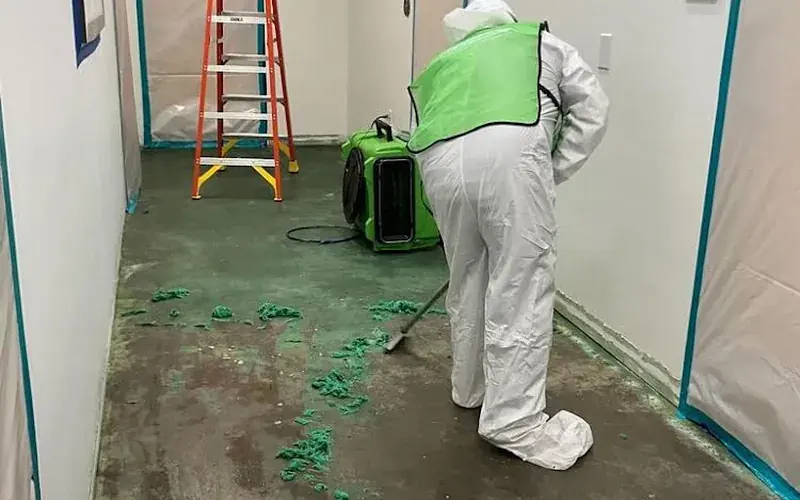
A sewer backup or a failed septic system is not a job for a mop and a pair of gloves. Black water carries bacteria and other hazards, and around Dale and Caldwell County, where many rural homes run on septic, these losses are common. The crew arrives in protective gear, extracts the contaminated water, removes what cannot be saved, and disinfects the area so your home is safe again, not just dry.
How sewage & black water cleanup is handled in Dale
Call & dispatch
The response team answers 24/7, gets your address, and sends the nearest Central Texas crew with truck-mounted extractors, air movers, and moisture meters.
On-site assessment
The crew finds the source and the full reach of the water, including what soaked into subfloor, cabinets, and the wall cavities you cannot see.
Extract & dry
The extraction crew pulls the standing water fast, then runs air movers and dehumidifiers to a measured dry standard, not just the surface.
Verify & document
Moisture readings are logged until the structure reads dry, then the loss is documented with the photos and daily readings an adjuster needs to move a claim.
Sewage backups and septic failures in Caldwell County
Out here, a lot of homes are on septic rather than a city sewer, which shapes the backups crews see. Whether municipal or private, the causes tend to fall into a few patterns.
- A saturated drain field after heavy rain, so a septic system cannot take any more and backs up into the house.
- A full or failing septic tank that has not been pumped, sending waste back up the lowest drains.
- Tree roots or a clog in the main line, backing sewage up through toilets, tubs, and floor drains.
- A municipal sewer surcharge during a heavy storm that pushes water back into connected homes.
Because a backup and a storm often arrive together, this work overlaps with the flood damage cleanup, and standing water still has to come out through water extraction and removal, with contamination controls in place.
Why black water is a health hazard
Sewage is classified as category three, or black water, the most contaminated class, which drives everything about how crews handle it. It is not about how it looks, it is about what is in it.
- Black water can carry bacteria, viruses, and parasites that pose a real health risk on contact or in the air.
- Porous materials it touches, like carpet, pad, and the bottom of drywall, usually cannot be disinfected and have to be removed.
- The longer it sits, the further the contamination and odor spread into materials that were not originally affected.
For plain references, the CDC guidance on water, sanitation, and hygiene in emergencies and the EPA pages on septic systems explain why sewage has to be handled as a hazard, not an ordinary spill.
The sewage cleanup and disinfection
The job is to remove the contamination completely and make the space safe, and every step is built around containment. One Lone Star Water Restoration crew works the whole process in protective gear, from sealing off the area and extracting the black water to disinfecting every surface and drying the structure to a verified reading.
Restoring the area safely
Getting a home back after a sewage loss means proving it is safe, not just clearing the mess. Black water and moisture are a fast track to mold, so drying and monitoring are part of the same job.
- Crews dry the structure through the structural drying process and watch for the mold that black water losses so often trigger.
- If growth has already set in, the mold remediation crew handles it under one plan.
- Crews document the loss with photos and readings and bill your carrier, and you can size up the range with the cost calculator first.
Sewage backing up in your Dale home? Call now. A Caldwell County crew arrives in protective gear to extract, disinfect, and make it safe, not just dry.
☎ Call (737) 302-5065Septic country needs a different playbook
Much of Caldwell County runs on septic, and after a heavy rain a saturated drain field can send waste back into the lowest drains in the house. A septic backup is black water, so it is not a wet vac and bleach job, it is a health hazard that has to be contained, extracted, and disinfected properly. Keep people and pets out of the area and call, because the fix is about decontamination, not just cleanup.
Why Dale and Caldwell County call the local pros first
Rapid local response
The response team answers 24/7, and the nearest crew heads out the moment you call, day or night, across Dale, Lockhart, Kyle, Buda, and San Marcos.
IICRC S500 drying standard
Trained crews with truck-mounted extractors, air movers, and moisture meters, drying to the IICRC S500 standard, not a mop and a box fan.
Claim-ready documentation
The loss is documented with photos and daily moisture readings, the paperwork an adjuster needs to move a claim.
Local water experts
Flash floods off Plum Creek, freeze bursts, and slab leaks on Blackland clay, so the local pros know how water moves through homes here.
Serving Dale, Caldwell County, and the corridor
Seated near Dale on FM 1854, the response team covers Caldwell County and the Kyle, Buda, and San Marcos corridor, day or night.
Seated near Dale on the FM 1854 corridor, local crews cover all of Caldwell County and the Kyle, Buda, and San Marcos corridor, day or night, with rapid local response.
Coverage runs across Dale, Lockhart, Kyle, Buda, San Marcos, Luling, Martindale, Maxwell, Niederwald, Uhland, Mustang Ridge, and Del Valle.
See every community and ZIP covered ›Related restoration services
Common questions, answered
How fast can you respond to a sewage backup in Dale?
Crews answer live 24/7 and reach most of Dale and Caldwell County. Sewage is a health hazard that spreads and soaks in the longer it sits, so a fast, contained response limits both the contamination and the amount of material that has to be removed.
Why can't I clean up sewage myself?
Sewage is category three black water, which can carry bacteria, viruses, and parasites that are dangerous on contact and in the air. Safe cleanup needs protective gear, containment, proper extraction and disposal, and real disinfection, not a wet vac and household bleach. Keep people and pets out of the area until it is handled.
We are on a septic system. Do you handle that?
Yes, and it is common out here. Many Caldwell County homes run on septic, and a saturated drain field or a full tank can back waste up into the lowest drains, especially after heavy rain. Crews handle septic backups the same careful way as a city sewer backup, with full containment and disinfection.
What has to be thrown away after a sewage backup?
Porous materials that soaked up black water, like carpet, pad, and the lower part of drywall, usually cannot be reliably disinfected and have to be removed. Hard, non porous surfaces can be cleaned and disinfected. Crews tell you what can be saved and what cannot, and why, before removing anything.
How do you get rid of the sewage smell?
The odor comes from the contamination and from moisture left in materials, so crews remove the source, disinfect every affected surface, and treat the air rather than masking the smell. Drying the structure fully is part of it, because damp materials keep an odor going.
Will a sewage backup cause mold?
It can, quickly. Black water plus the humidity here is a fast track to mold, so after decontamination crews dry the structure to a verified reading and watch for growth. If mold has already started, the remediation crew handles it under the same plan.
Does insurance cover sewage cleanup?
Many policies cover sudden sewer or drain backups, sometimes through a specific backup endorsement, though coverage varies. The loss is documented thoroughly with photos and readings for your carrier, so the claim is supported and you know where you stand.
What areas do you serve for sewage cleanup?
All of Dale and Caldwell County plus the surrounding communities, including Lockhart, Luling, Martindale, Maxwell, Prairie Lea, and the Kyle and Buda corridor, both septic and city sewer properties. A dispatcher answers around the clock.
Dale's water damage crew is standing by
Water sitting means damage spreading. Call Lone Star Water Restoration and a local crew heads out across Caldwell County, day or night.
(737) 302-5065Talk to a Central Texas crew now, day or night