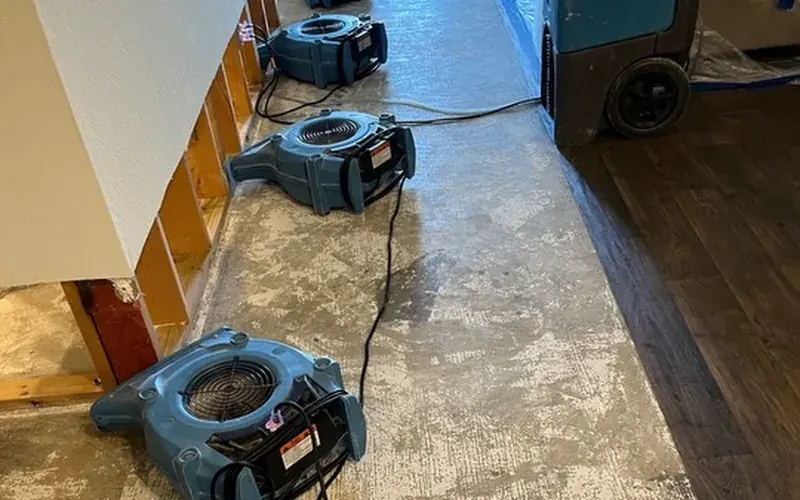
Getting the standing water out is only half the job. Water soaked into the slab, drywall, and framing has to dry to a measured, verified reading, or it comes back as warped floors, peeling paint, and mold. In Central Texas humidity that takes real equipment and a few days of monitoring, not a fan and an open window. The crew sets air movers and dehumidifiers, tracks the readings daily, and dries your home right, across Dale and Caldwell County.
How structural drying & dehumidification is handled in Dale
Call & dispatch
The response team answers 24/7, gets your address, and sends the nearest Central Texas crew with truck-mounted extractors, air movers, and moisture meters.
On-site assessment
The crew finds the source and the full reach of the water, including what soaked into subfloor, cabinets, and the wall cavities you cannot see.
Extract & dry
The extraction crew pulls the standing water fast, then runs air movers and dehumidifiers to a measured dry standard, not just the surface.
Verify & document
Moisture readings are logged until the structure reads dry, then the loss is documented with the photos and daily readings an adjuster needs to move a claim.
Drying a home the right way in Central Texas humidity
Drying is a controlled process, and the humid climate here makes it harder than most. Opening windows and running box fans just moves damp air around and can make things worse.
- Dehumidifiers pull moisture out of the air so wet materials can release their water.
- Air movers push air across walls, floors, and cavities to speed evaporation.
- The two work as a system, balanced to the size and dampness of the space for fast, complete drying.
This is the step that follows water extraction and removal, and doing it properly protects the slab and structure long after the visible water is gone.
Air movers, dehumidifiers, and monitoring
What separates real structural drying from a rented fan is measurement, not a guess about how a room looks.
- Crews place equipment for the specific loss, then check moisture with meters and a thermal camera on each visit.
- Crews adjust the air movers and dehumidifiers as readings drop, moving them to the spots still holding water.
- Crews log the readings so there is a documented record the structure reached a dry standard, which your insurer will want to see.
The EPA guidance on mold and moisture control and the CDC pages on dampness and mold are plain references on why wet building materials must be dried quickly and fully, not just wiped down.
Why slabs and drywall need days, not hours
People are often surprised drying takes several days, because water hides inside dense materials and gives it up slowly, especially in the humidity here. A concrete slab, the base of the drywall, and the framing behind it hold moisture deep inside where a surface fan never reaches. One Lone Star Water Restoration crew keeps the drying system running until the meters confirm those materials are dry all the way through, typically three to five days. Pull the equipment early and the trapped moisture migrates back out and feeds mold. Get a sense of the timeline for your loss with the drying time estimator.
Preventing mold during drying
Mold cannot grow on a properly dried surface, and in the climate here it can take hold within 24 to 48 hours, so speed matters as much as thoroughness. Crews map the moisture, set and balance the equipment, control the humidity, and monitor daily until every reading hits target, then log the results. If the water sat long enough that mold has already started, the mold remediation crew steps in under the same plan.
Water already extracted but your Dale home still feels damp? Call now. Crews set air movers and dehumidifiers and dry the structure to a verified reading, not just the surface.
☎ Call (737) 302-5065The humidity here is why drying cannot be rushed
In a dry climate a wet wall might air out on its own. Here, warm Gulf humidity keeps moisture locked in the slab and drywall, which is why dehumidification matters more in Central Texas than almost anywhere. A home that feels dry on the surface after a leak off Plum Creek or a burst line can still be soaked inside, so crews dry to a measured reading and document it.
Why Dale and Caldwell County call the local pros first
Rapid local response
The response team answers 24/7, and the nearest crew heads out the moment you call, day or night, across Dale, Lockhart, Kyle, Buda, and San Marcos.
IICRC S500 drying standard
Trained crews with truck-mounted extractors, air movers, and moisture meters, drying to the IICRC S500 standard, not a mop and a box fan.
Claim-ready documentation
The loss is documented with photos and daily moisture readings, the paperwork an adjuster needs to move a claim.
Local water experts
Flash floods off Plum Creek, freeze bursts, and slab leaks on Blackland clay, so the local pros know how water moves through homes here.
Serving Dale, Caldwell County, and the corridor
Seated near Dale on FM 1854, the response team covers Caldwell County and the Kyle, Buda, and San Marcos corridor, day or night.
Seated near Dale on the FM 1854 corridor, local crews cover all of Caldwell County and the Kyle, Buda, and San Marcos corridor, day or night, with rapid local response.
Coverage runs across Dale, Lockhart, Kyle, Buda, San Marcos, Luling, Martindale, Maxwell, Niederwald, Uhland, Mustang Ridge, and Del Valle.
See every community and ZIP covered ›Related restoration services
Common questions, answered
How long does structural drying take in Central Texas?
Most homes dry in three to five days, though it depends on how much water there was, how long it sat, and how humid it is. Crews take moisture readings every day and keep the equipment running until the slab, drywall, and framing reach a verified dry target, not just a dry looking surface.
Why can't I just use fans and open the windows?
In the humid climate here, opening windows lets warm, moist Gulf air in, which slows drying instead of speeding it. Box fans move damp air around but do not remove moisture. Real drying pairs air movers with dehumidifiers that actually pull the water out of the air so materials can release it.
How do you know when my home is actually dry?
Crews set target moisture readings for each material at the start, then measure with meters and a thermal camera every day until those targets are met. Crews log the readings so there is a documented record the home reached a dry standard, which your insurer will want to see.
What happens if the drying is stopped too early?
The moisture trapped deep in the slab, drywall, and framing migrates back out, and in the Texas heat that damp can feed mold within a day or two. That is why crews dry to a measured reading and verify it, rather than pulling the equipment the moment the floor looks dry.
Is the drying equipment loud or disruptive?
Air movers and dehumidifiers do run continuously, which is necessary for fast drying, and there is some noise and warmth while they work. Crews place them to dry the home as quickly as possible so the equipment comes out sooner, and crews walk you through what to expect.
Do you dry the concrete slab too?
Yes. Central Texas homes are slab on grade, and a concrete slab holds water deep inside where a surface fan never reaches. Crews monitor the slab specifically and keep drying until it reads dry, because a damp slab under new flooring causes problems later.
Does drying prevent mold?
That is the main point of fast, complete drying. Mold cannot grow on a properly dried surface, so bringing the moisture down quickly and fully is the front line against it. If mold has already started because the water sat too long, the remediation crew handles it under the same plan.
Will insurance cover structural drying?
Sudden accidental water losses are usually covered, including the drying phase. Daily moisture logs and photos give your carrier the documentation they need. Coverage depends on your policy, so it is worth checking with your own insurer.
Dale's water damage crew is standing by
Water sitting means damage spreading. Call Lone Star Water Restoration and a local crew heads out across Caldwell County, day or night.
(737) 302-5065Talk to a Central Texas crew now, day or night